Though I've taken in a fair amount of Go related reading, aiming to throw myself into the online arena with some semblance of experience, I've procrastinated a bit in order to try my hand at a problem set; my very first problem set, in fact. Most readers will be familiar with it: Graded Go Problems Vol. 1 by Kano Yoshinori. Why did I start with her text?
A lot of the free problem sets available on "teh internets" suffer from some common ailments. Most are simply too difficult. Judging from personal experience I'd say the great majority of Go problems are aimed at intermediate players looking to master difficult formations like the "Rabbity Six" or else improve their speed and fluency with simpler problems of perception, such as forcing semeai in a pinch. Otherwise, most problems come with inadequate or no solutions at all. I've seen a few places where the community is allowed to discuss a problem, proposing alternate solutions, but it is relatively rare. A beginner like myself needs a clear cut solution to every problem. We also need to start at the most rudimentary level, solving problems that may seem ludicrously facile to a 15 kyuu.
Go, like so many other academic subjects, builds on itself. A keen understanding of the basic tenets of the game is essential to grasping the more complicated ones. For example, a good player should be able to recognize the beginnings of a ladder or net by mere familiarity. It is unlikely a beginner will be able to do the same. At the very start of their playing career he or she will meticulously calculate the position and steps that will lead to a ladder, understand what placement leads to where, and whether it is either beneficial or detrimental to their overall board position. While it is just as good to figure it out in a live game, it is useful to have practiced it well before hand in problem sets. As in Yoshinori's book, by presenting the same problem category to a player in a myriad different board configurations a player learns to recognize the base ordering by picking it out of the board. In essence they are detecting a signal amongst a great deal of "noise". From there rote repetition will do its work and a beginner will soon turn into an intermediate, but it must begin somewhere, and it must begin solidly.
A few cursory attempts at the same kind of problem will not yield a mastery of the subject, though a player may feel confident about their skills. When they approach the next and more difficult problem, the one that builds on the previous problem's challenge, they'll find it needs not only a new level of ingenuity to solve, but also the firm understanding of the basic idea it builds upon. If there is even the slightest vitiation in their understanding of the elementary crux of the challenge it will be a distraction from the efforts needed to consider the greater depth in the more difficult problem.
Yoshinori's book indulges that British schoolmaster side of me that likes to see a repetitious education process slowly and painfully hammer the simplest rules into a student's fragile gray matter. The problems repeat themselves, over and over again, inculcating the same lesson until it becomes a sort of neural scar tissue - as tenable and cardinal as gravity or hunger. A well trained Go player should snarl and jump at basic threats, feral even in the midst of such a refined game. Their thoughts will be on higher planes of meditation, leaving baser worries and woes to tooth and fang, or in this case, in the care of rote memorization and recognition.
There is of course the worry that this might happen:
But that's a much higher degree of the phenomenon. No doubt Yasuhiro was peering through space and time, conversing with an ethereal, misty visage of fat, when he made that move. It is probably a stone placement of significant cosmic importance, but of terrible detriment in what is,in the end, a mere base game. At least, that's how I like to explain it.
Next post: The Banana Peels of Go - Unlikely Sources of Trickery And Treachery for the Beginner, sourced from Go Problems
Thursday, August 30, 2007

Tuesday, August 28, 2007
Represented in the Cabinet
There are a lot of political interests and faction strife that go into the making of a new Japanese cabinet, but I never thought I'd see a dedicated Go player make it to the top. The author of Shisaku has composed a complete roster of Japanese Prime Minister's post-defeat cabinet. Apparently, the new Cabinet Secretary, Yosano Kaoru, is a Go player and a good one at that. Scroll to the bottom of the page to find a picture of the adept 7 dan politician playing a game. Anyone care to analyze?
I mentioned this curious find to a friend of mine, who keeps me abreast of developments in Chinese literature in exchange for news on movements in the Japanese political scene.
He replied, "Who has the time to be a cabinet secretary and an expert Go player?".
"Not sure."
"Well, I guess it makes sense. Japanese 7 dan isn't what it used to be."
Zing!
Personally I'm waiting in rapt suspense for Yosano to excercise some of his Go knowhow in the current stage of his political career. Imagine him urging the LDP to take sente during a heated campaign for the House of Representatives, or making an appearance at a tournament to curry the favor of the parochial Go community.
I mentioned this curious find to a friend of mine, who keeps me abreast of developments in Chinese literature in exchange for news on movements in the Japanese political scene.
He replied, "Who has the time to be a cabinet secretary and an expert Go player?".
"Not sure."
"Well, I guess it makes sense. Japanese 7 dan isn't what it used to be."
Zing!
Personally I'm waiting in rapt suspense for Yosano to excercise some of his Go knowhow in the current stage of his political career. Imagine him urging the LDP to take sente during a heated campaign for the House of Representatives, or making an appearance at a tournament to curry the favor of the parochial Go community.
Saturday, August 25, 2007
Janice Kim's "Learn to Play Go - Vol. 1"
Just as any good author or academic would check their work against antipodal takes on their subject, so should a professional recieve council from more than one source. After happily ruminating on Cho Chikun's introductory tour of Go I decided to peruse the readings of another oft-suggested author, the infamous Janice Kim. 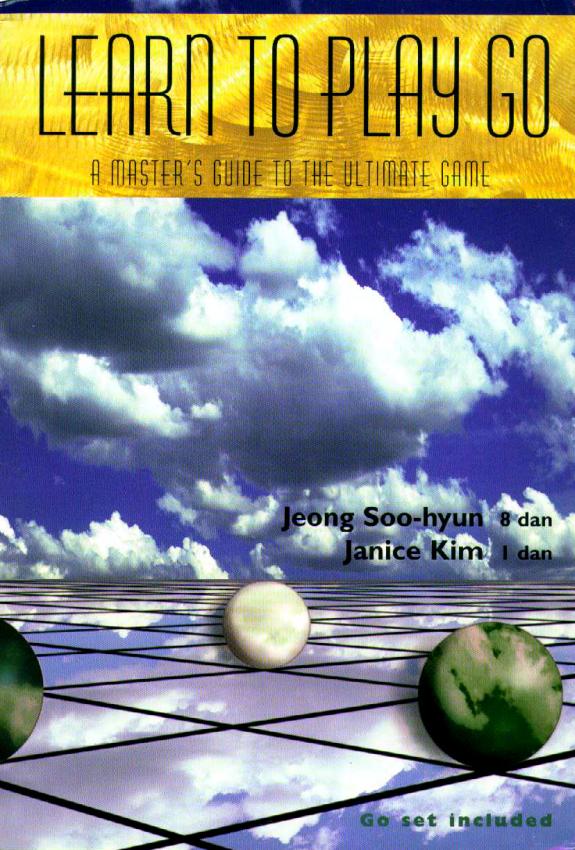
In terms of subject matter and material, Janice Kim's first volume just about matches Cho's book. It spends a little more time on rudimentary basics, but covers the necessary building blocks to a good, correctly played Game of Go including ladders, nets, eyes and sound placement. But it's not what "Learn to Play Go" reviews that gives it a welcome place on the avid Go player's shelf, but how it presents that information. Go can be a cryptic and confounding game, even in its simplest shape. A cautious and lenient instructor is then required to translate the game's often incomprehensible logic into a more palatable form for the complete beginner. Kim does exactly that with her flair for capacious page design and a zen simplicity that trims excess verbiage and keeps the bare essentials.
Open the book to any page and you'll immediately find that diagrams and explanations are logically and clearly paired. There's no need to play a matching game between the expalantion for diagram 2a and the drawing that happens to be two pages away. Furthermore, there are generous margins between blocks of text and between images. Although this may seem trivial, a new player will need as few distractions as possible when staring at a diagram and playing out a complicated sequence. For example, the best way to understand a ladder is to play it out in one's mind. Doing so allows the player to see how a ladder starts and what it looks like in its primordial shape. It also encourages players to recognize when a ladder will hit or miss a stone further out in the board. However, deep meditation on the diagram may be interrupted or sidetracked by quick eye jerks to nearby text, or an adjacent figure. Suddenly the meticulously tracked ladder has vanished, and with it the patience of the frustrated student. One could play it out on the board and garner most of the aforementioned benefits, but as an advocate of the mental anguish and the successive benefits of mind play, I believe Kim's layout and design provide the best platform for strenuous, dedicated introductory study.
I do wonder about the erratic sketches found on almost every page of the book. At first they have some semblance to Go stones and grid lines, but later these frivolous doodles turn into irrelevant depictions of houses, windows, and tall six-legged creatures. Most are tucked towards the bottom of the page, far and away from anything they could detract from, but sometimes you'll be cruising along a lengthy explanation of Go theory only to fixate your eye on a monstrous stick figure of a crooked bicycle atop an elephant. Disturbing? Yes. Distracting? Thankfully, no.
If Cho Chikun's Go introduction seems a bit thick, then by all means give Janice Kim's version a try. It surrenders the more complicated discourses on third and fourth line placement to focus on secure understanding of elementary tactics - in other words, the most solid foundation available.
In terms of subject matter and material, Janice Kim's first volume just about matches Cho's book. It spends a little more time on rudimentary basics, but covers the necessary building blocks to a good, correctly played Game of Go including ladders, nets, eyes and sound placement. But it's not what "Learn to Play Go" reviews that gives it a welcome place on the avid Go player's shelf, but how it presents that information. Go can be a cryptic and confounding game, even in its simplest shape. A cautious and lenient instructor is then required to translate the game's often incomprehensible logic into a more palatable form for the complete beginner. Kim does exactly that with her flair for capacious page design and a zen simplicity that trims excess verbiage and keeps the bare essentials.
Open the book to any page and you'll immediately find that diagrams and explanations are logically and clearly paired. There's no need to play a matching game between the expalantion for diagram 2a and the drawing that happens to be two pages away. Furthermore, there are generous margins between blocks of text and between images. Although this may seem trivial, a new player will need as few distractions as possible when staring at a diagram and playing out a complicated sequence. For example, the best way to understand a ladder is to play it out in one's mind. Doing so allows the player to see how a ladder starts and what it looks like in its primordial shape. It also encourages players to recognize when a ladder will hit or miss a stone further out in the board. However, deep meditation on the diagram may be interrupted or sidetracked by quick eye jerks to nearby text, or an adjacent figure. Suddenly the meticulously tracked ladder has vanished, and with it the patience of the frustrated student. One could play it out on the board and garner most of the aforementioned benefits, but as an advocate of the mental anguish and the successive benefits of mind play, I believe Kim's layout and design provide the best platform for strenuous, dedicated introductory study.
I do wonder about the erratic sketches found on almost every page of the book. At first they have some semblance to Go stones and grid lines, but later these frivolous doodles turn into irrelevant depictions of houses, windows, and tall six-legged creatures. Most are tucked towards the bottom of the page, far and away from anything they could detract from, but sometimes you'll be cruising along a lengthy explanation of Go theory only to fixate your eye on a monstrous stick figure of a crooked bicycle atop an elephant. Disturbing? Yes. Distracting? Thankfully, no.
If Cho Chikun's Go introduction seems a bit thick, then by all means give Janice Kim's version a try. It surrenders the more complicated discourses on third and fourth line placement to focus on secure understanding of elementary tactics - in other words, the most solid foundation available.
Friday, August 17, 2007
They Just Go Together
A friend of mine came to town recently after a long absence spent in the nether regions of Texas. We immediately scheduled a meeting. I suggested we host a beer sampling, while he countered with a proposed game of Go. So we did both. The vast majority of the game was spent with an English ale - lots of caramel, chocolate and malts. Being a self-labeled beer connoisseur it seemed like the ideal drink to an ideal game. But a creeping feeling told me that something was awry, and before I knew it I was clamoring for a robust green tea. Somehow the ale had been rejected by the board and stones' aesthetic aura, and in its place a sudden inclination for Genmai-cha.
I have never before fallen out of the mood for a beer, or so strongly fallen into the mood for tea.
It is a small detail, and probably an insane one for those without gustatory leanings, but all the same proves how Go can often work on a subconscious level.
I have never before fallen out of the mood for a beer, or so strongly fallen into the mood for tea.
It is a small detail, and probably an insane one for those without gustatory leanings, but all the same proves how Go can often work on a subconscious level.
Subscribe to:
Posts (Atom)