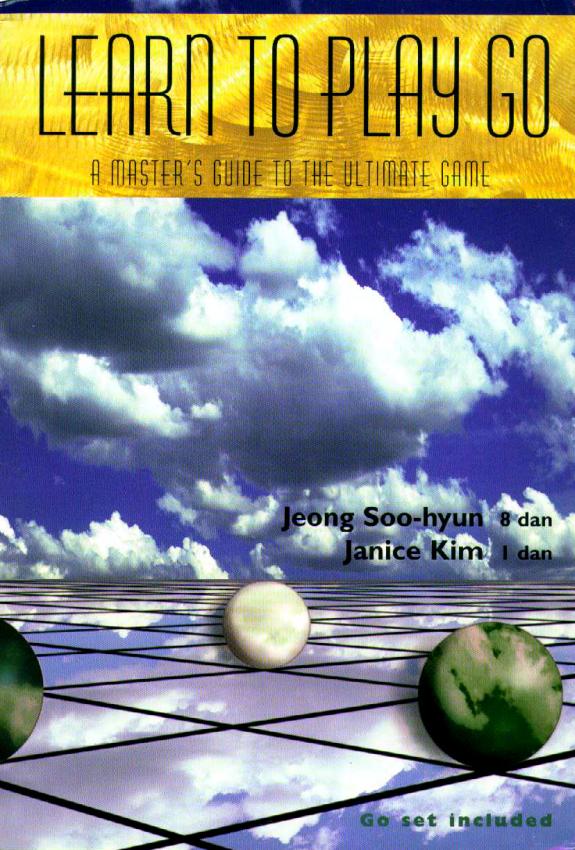
In terms of subject matter and material, Janice Kim's first volume just about matches Cho's book. It spends a little more time on rudimentary basics, but covers the necessary building blocks to a good, correctly played Game of Go including ladders, nets, eyes and sound placement. But it's not what "Learn to Play Go" reviews that gives it a welcome place on the avid Go player's shelf, but how it presents that information. Go can be a cryptic and confounding game, even in its simplest shape. A cautious and lenient instructor is then required to translate the game's often incomprehensible logic into a more palatable form for the complete beginner. Kim does exactly that with her flair for capacious page design and a zen simplicity that trims excess verbiage and keeps the bare essentials.
Open the book to any page and you'll immediately find that diagrams and explanations are logically and clearly paired. There's no need to play a matching game between the expalantion for diagram 2a and the drawing that happens to be two pages away. Furthermore, there are generous margins between blocks of text and between images. Although this may seem trivial, a new player will need as few distractions as possible when staring at a diagram and playing out a complicated sequence. For example, the best way to understand a ladder is to play it out in one's mind. Doing so allows the player to see how a ladder starts and what it looks like in its primordial shape. It also encourages players to recognize when a ladder will hit or miss a stone further out in the board. However, deep meditation on the diagram may be interrupted or sidetracked by quick eye jerks to nearby text, or an adjacent figure. Suddenly the meticulously tracked ladder has vanished, and with it the patience of the frustrated student. One could play it out on the board and garner most of the aforementioned benefits, but as an advocate of the mental anguish and the successive benefits of mind play, I believe Kim's layout and design provide the best platform for strenuous, dedicated introductory study.
I do wonder about the erratic sketches found on almost every page of the book. At first they have some semblance to Go stones and grid lines, but later these frivolous doodles turn into irrelevant depictions of houses, windows, and tall six-legged creatures. Most are tucked towards the bottom of the page, far and away from anything they could detract from, but sometimes you'll be cruising along a lengthy explanation of Go theory only to fixate your eye on a monstrous stick figure of a crooked bicycle atop an elephant. Disturbing? Yes. Distracting? Thankfully, no.
If Cho Chikun's Go introduction seems a bit thick, then by all means give Janice Kim's version a try. It surrenders the more complicated discourses on third and fourth line placement to focus on secure understanding of elementary tactics - in other words, the most solid foundation available.

2 comments:
good book
thnx
you need to look up the definition of "infamous".
otherwise, i agree this is a great introduction to the game for absolute beginners....
Post a Comment