To follow up on the previous post discussing beginner's intuition and why it's detrimental to always hermetically seal off your territory, here's another example where locking in that last stone for a clear-cut block of territory will ultimately end up losing it for the player.
Diagram 1
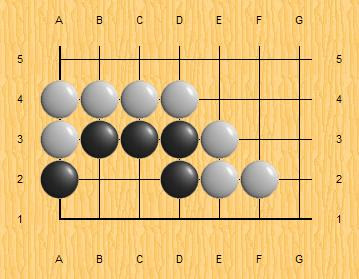
Let's assume it is black's turn. His perogative is to defend the corner territory and settle it in his favor. That means giving the group life, but it must be done cautiously. They may first be tempted to put a stone at D1. This would presumably keep White from invading. By all appearances black has barred all the entrances. How could white possibly invade such a small space? Easy. Go is not a game of strict terra firma movement. Stones can "parachute" in behind enemy lines where appropriate. This is common when a player tries to cordon off too much territory. Their opponent will simply slip a stone somewhere behind the bulwark of stones and start making a living shape. But this is a bit different. It's a much smaller space, encompassing a mere five grid points. So how could white invade to cripple black's group?
When plack plays at D1 he's made a terrible formation. At least, terrible for him. Put a stone at D1 and suddenly the territory is a "Bulky 5" or "The Jeep". And like many other common groups of four, five, or six spaces, there's a "critical" point that can make or break the whole group. In a bulky five it is in the middle of the three space row or, to continue the analogy, under the chassis of the jeep between axels. In this case it is B1. Now that black has formed the Bulky 5 with D1, white can go ahead and play the critical point. Once has done so there is no way for white to recooperate. The group is dead.
If, instead of playing at D1 white had played at B1 first he has secured life for the group, though it may not look like it. If white next attacks at D1, black smirks and replies at C1. The two eyes are in place. One is at A1 and the other is a two point eye space - B2 and C2. If white takes a conservative tack and approaches at E1 then black responds at D1 and, again, two eyes appear.
Playing the Bulky 5's critical point requires the beginner to use some foresight.
When plack plays at D1 he's made a terrible formation. At least, terrible for him. Put a stone at D1 and suddenly the territory is a "Bulky 5" or "The Jeep". And like many other common groups of four, five, or six spaces, there's a "critical" point that can make or break the whole group. In a bulky five it is in the middle of the three space row or, to continue the analogy, under the chassis of the jeep between axels. In this case it is B1. Now that black has formed the Bulky 5 with D1, white can go ahead and play the critical point. Once has done so there is no way for white to recooperate. The group is dead.
If, instead of playing at D1 white had played at B1 first he has secured life for the group, though it may not look like it. If white next attacks at D1, black smirks and replies at C1. The two eyes are in place. One is at A1 and the other is a two point eye space - B2 and C2. If white takes a conservative tack and approaches at E1 then black responds at D1 and, again, two eyes appear.
Playing the Bulky 5's critical point requires the beginner to use some foresight.
To many newbies the above problem does not look like the Bulky 5 unti a stone is played at D1. However, a player should begin to recognize instances where a formation or space is an embryonic form of the Bulky 5, thereby avoiding an egregious mistake like black's initial defense at D1. It's only a one stone play, but making life requires the predictive power to see that one stone, and the knowledge to assess the Bulky 5 as a very dangerous group if left to the opponent to strike at it's vital point.

No comments:
Post a Comment