I'm going to be honest. The first book in the "Graded Go Problems" series is ever so slightly too easy. Most of the problems give the reader an extraordinarily facile challenge. The answers are so brutally obvious it's hard to see how anybody could miss. There are exceptions, of course, but the greater fraction of the many, many problems let you either kill yourself and disgrace your family name OR make life and crush your opponent, vandalizing his entire career record and then you, the valiant and honored hero gets whisked away on a sea of admirer's arms. What I have here is a sampling of those problems that bring up interesting questions. CAVEAT: The so-called interesting questions are interesting so far as my troglodyte understanding of the game permits. This will be maddeningly boring to anybody with a larger brain mass than say, a canary.
The first diagram here is the most lucidly clear example of the a phenomena that occurred repeatedly through the text. Note - Stone configuration is changed a bit to keep any chance of copyright infringement at bay.
Diagram 1
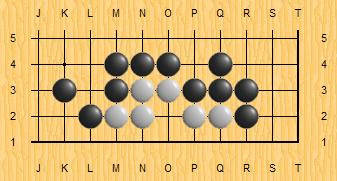
Speaking on my own behalf, which is convenient since I am the one typing, this kind of problem is deceptively easy. You are white. The opponent is black. He is trying to sneak his way behind the lines to kill your group. You are resisting his efforts, desperately mortaring stones together to make a wall of Babylonian proportions. Your first, tyro instinct is to complete one side of the fortification at either M1 or Q1 thereby cutting off black's invidious advance. Let us say you do at Q1. This permits Black to encroach at M1 (or vice-versa if the white stone goes to M1). Once he's made that attack you can block again at N1, forcing Black to reinforce himself at L1. Now you have a 3 space grouping that can form two eyes once a stone is placed at O1 and you've made all of two territory points. Congratulations. You're new territory will forever be known as "The Most Cramped Place in the World - Yes, Even More Cramped Than Tokyo". If, at the beginning you placed your first protective stone at R1 instead of Q1 you'd still need to place at Q1 to keep black from breaking through.
Let's restart. We must now defy instinct. All those games of Warcraft II where you built walls from edge to edge to keep out the fulsomely cheap Orcs are at an end. This is Go, and the essence of Go is finesse. Not moisture. We must find a place where any kind of encroachment is futile. We want black to either waste his time invading or, at the very least, leave him in a place where he realizes it is futile and plays elsewhere. Where's that spot?
O1. Now you've made two eyes. Well, almost. If black attacks at M1 or Q1 (P1 and N1 result in immediate capture now that O1 white is in play) white forms eye #2 at the spot left unoccupied. So, if black attacks at M1, white makes two eyes at Q1. Is this advantageous?
In the first example we used two stones to secure 2 spaces. In the second example we ultimately use two stones to secure 2 spaces. Perhaps it is not so good after all...
EDIT: As the kind commenter pointed out, black can also just do away with white by playing at the coveted O1 spot first. This nullifies that precious eye making point that is critical to both approaches. The above examples were to show that a beginner vs. beginner periphery fight would be stylistically and pragmatically inferior to the simple "whoever plays O1 takes all".
Let's look at Diagram 2.
Diagram 2
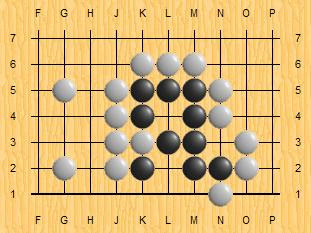
The roles are reversed. Black is fending off white, who is slowly snaking his way around black's hind flanks. It's time for rear guard action. This is somewhat similiar to Diagram 1, except things are a bit more precarious. Black is on the precipice of death, and any foul-up will result in a huge win for white. So, let's take the first solution from the first example and apply it here. That means we wall off the open sides and hope white doesn't leak in. Does it work?
A black stone at M1 does indeed keep white from moving any further in on that particular side. The left side is a bit different. Now that black has moved his reinforcements into M1, white takes the opportunity to stroll into K1. Black is forced to counter at L1, but alas, this ends in a false eye and black is vanquished. There is now a Ko and a lot of black stones in line for the guillotine. What if black defends first at K1? White now takes M1, forcing black to defend at L1. White reinforces his invasion at O1 to keep black from taking two prisoners. But now black looks at his configuration, and it is grim indeed. The triad of stones at K2, K1 and L1 compose a false eye. The group is dead, and woe unto black, for his efforts are undone!
Now, let's say black puts down a stone on L1 from the very start. He is attempting a defense well away from his walls, leaving big open spaces for rapacious conquerors. It looks bad and feels bad, and the neophyte will get queasy, but not once they see they've made life. White can approach at K1, but white secures two eyes by simply placing a stone at M1. Alternately, white attacks at M1, but suddenly he's short liberties, has self-atari'd and black picks up two stones. All because black played away from the walls.
ANOTHER EDIT: Again, kudos to the commenter. In this case, white attacking at K1 DOES NOT lead to a ko unless white perpetually assaults black at L2 to keep the ko alive. Indeed, the smarter move here is to simply reinforce white's position with a stone at J1. Furthermore, if black did make the smart move and play at L1, white cannot approach at K1 for fear of black immediately capturing it with J1. Thanks again for the help!
My purpose here is to teach the beginner how to break away from the wall mindset when the situation demands it. Lots of beginner books stress that Go is a game about territory. They are right. They also stress that you need to mark and protect territory. They are right. But sometimes you have to play "in" to protect your territory from your opponent. It is not intuitive. The first reflex is to wall off that section of the board for good, but as evidenced by the situation in Diagram 2 it is not always the wisest choice.
This, I think, is the most interesting lesson culled from "Graded Go Problems for Beginners Vol. 1", at least for the uninitiated.

2 comments:
Hi,
I think you're wrong with serveral things in your article about those two life and death problems.
First, for Diagram 1, O1 is just the only move to live. White Q1 (or M1) would be answered by Black O1 and White is dead.
O1 is the vital point to make two eyes for White.
Second, for Diagram 2, if Black M1 and White K1, Black L1 don't lead to a ko since White will simply
connect at J1 (Black is dead).
If Black play L1 to live, White can't approach at K1 since this stone would be in atari, so Black
would take it imediatly with J1 (if Black L1 instead, White connect at J1 and Black is dead).
I hope this will help you a bit.
Elze,
Thank you very much for the corrections. I do not profess to be any kind of expert on Go. Only a beginner who sympathizes with other beginners and tries to pawn off his own educational epiphanies to others. Help like yours will undoubtedly be essential to the development of myself as a player, but also a great service to "Stone Drop". Thank you again for the clarification.
Post a Comment